The AI CapEx Time Bomb: Why Today’s Cheap Market is an Accounting Illusion

To the casual observer, a forward P/E ratio of 22x for the S&P 500 looks reasonable for an AI-driven bull market. Tech giants are posting soaring net incomes, and hardware vendors are booking historic revenues.
But a massive structural mismatch is hidden deep within corporate ledgers. Today's corporate earnings are being artificially flattered by an accounting timing trick, masking the true operational risks of the AI infrastructure boom.
The Core Asymmetry: Boom Now, Pay Later
The tech ecosystem is operating on a dangerous accounting disconnect:
The Sellers (Immediate Profits): When hardware giants sell AI chips, they book revenue and profits instantly.
The Buyers (Deferred Costs): The tech "hyperscalers" (Alphabet, Amazon, Meta, Microsoft, and Oracle) do not expense these multi-billion-dollar purchases upfront. Instead, they capitalize them—shunting the costs onto their balance sheets and trickling them onto income statements via Depreciation and Amortization (D&A) over several years.
The "Golden Window": We are living in a temporary macroeconomic sweet spot. The supplier revenues are fully captured today, while the hyperscalers' true costs are kicked down the road. This leaves corporate profit margins looking deceptively high.
The Great Disconnect: Net Income vs. Cash Flow
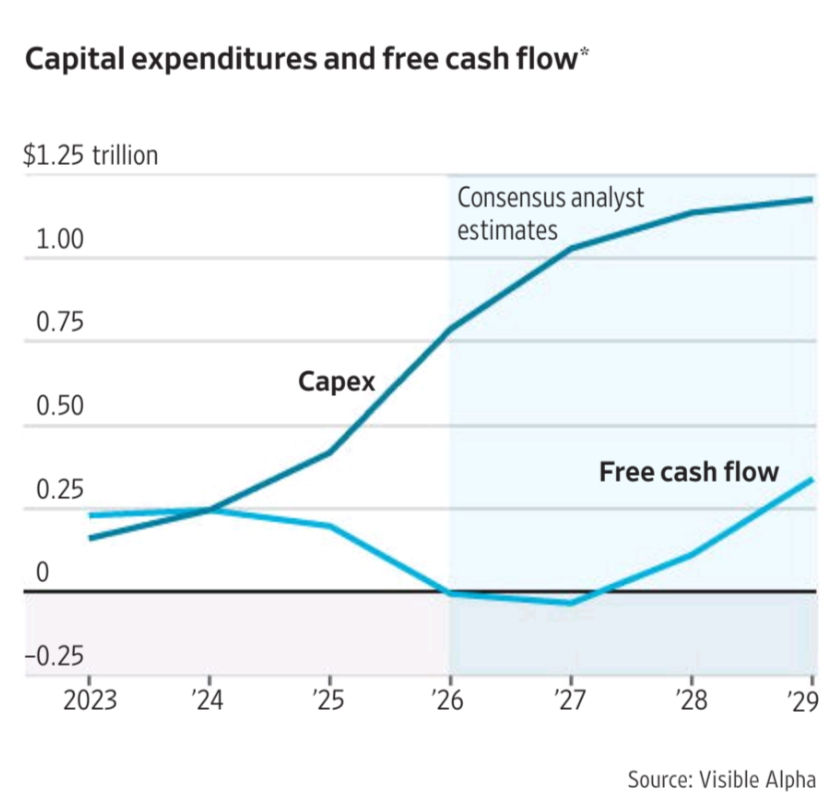
The sheer scale of this divergence is clear when looking at consensus forecasts for the big five hyperscalers:
Free Cash Flow Plummets (-91%): Driven by relentless data center builds, their combined free cash flow is projected to drop to just $16 billion. Cash flow will turn negative at Amazon and Oracle, and hover near zero at Meta.
Net Income Surges (+25%): Simultaneously, their reported accounting net income is projected to rise to $506 billion.
This gap exists because if a facility is still under construction, the depreciation clock hasn’t even started ticking. Real cash is flying out the door, but paper profits remain pristine.
The Analyst Blind Spot
The most alarming metric is Wall Street’s complete inability to model this future drag. While consensus estimates for future revenues are tightly aligned, the standard deviation for 2028 depreciation estimates blows out to 24% of the average.
Because these mega-cap firms historically operated asset-light software models, managing massive physical infrastructure is an entirely new paradigm. Furthermore, management has wide discretion to change an asset's "useful life" (e.g., stretching a server's life from 3 to 5 years), giving them the power to instantly manipulate paper earnings.
Takeaways
The Market is on a Monetization Timer: Investors are making a blind bet that by the time these data centers go fully online and depreciation hits the fan, AI software revenues will have scaled exponentially to absorb the hit. If those revenues don't arrive in time, future net income will contract sharply.
Passive Index Risk: Because the major indices are market-cap weighted, passive investors are highly exposed to this single theme. A stall in AI monetization means a multi-year depreciation hangover that will suppress mega-cap margins for years.
The Bottom Line: The market is fundamentally more expensive than it looks. True risk management requires looking past smoothed income statements and tracking the physical, asset-heavy cash cycles driving the market today.
-Chart from WSJ


Comments