Big Tech’s "Miracle on Costs": Are Wall Street’s AI Assumptions Too Good to Be True?
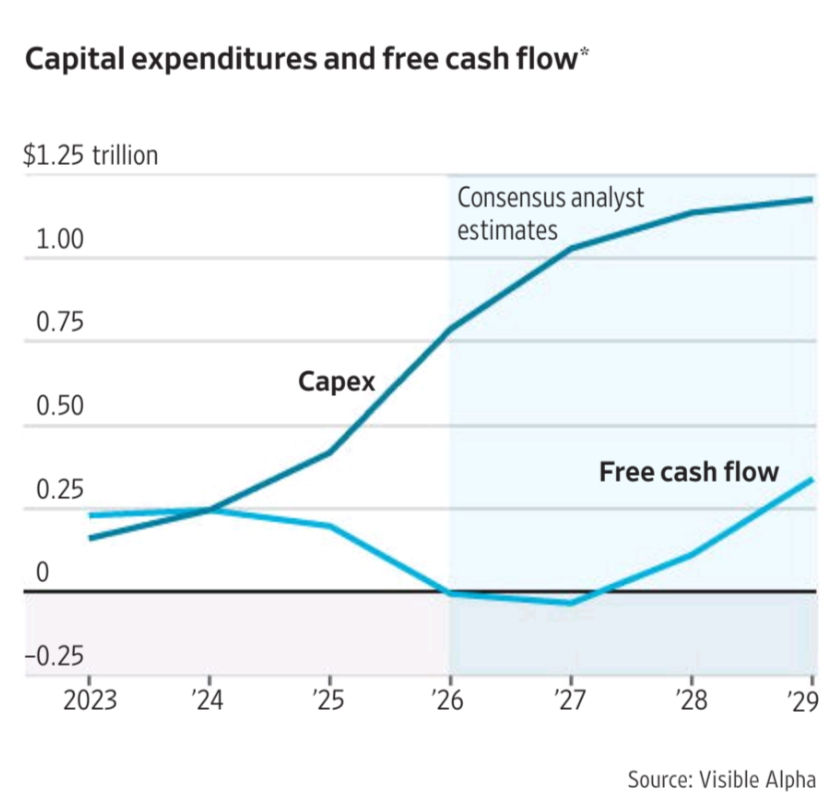
Wall Street’s current narrative for Big Tech hyperscalers—Alphabet, Amazon, Meta, Microsoft, and Oracle—requires a massive leap of faith. Analysts are betting these tech giants can scale AI revenue exponentially while simultaneously shrinking their operational overhead.
However, looking under the hood of these financial models reveals assumptions that stretch historical precedent to its limit.
The Core Bull Case: Unprecedented Margin Expansion
To justify current stock valuations, consensus analyst models rely on a dramatic widening of operating margins over the next six years:
Operating Margins: Projected to jump from 27% in 2023 to ~31% by 2029 across the five hyperscalers—the highest group level since Meta went public in 2012.
The SG&A Drop: Roughly half of this margin expansion relies on Sales, General, and Administrative (SG&A) costs dropping from 10% of revenue down to ~8% by 2029.
The Dollar Scale: Because combined annual revenue is expected to top $3 trillion, a mere 2% drop in SG&A represents $77 billion in reduced corporate spending in 2029 alone.
The Accounting Reality: Capex vs. Fixed Depreciation
While analysts model falling overhead, Big Tech is pouring trillions into AI data centers, chips, and physical infrastructure. Under standard accounting principles (GAAP), that capital expenditure translates into unavoidable fixed costs:
Soaring Depreciation (D&A): As new data centers go live, Depreciation & Amortization expenses will surge as a percentage of revenue.
No Room for Error: Because depreciation costs are locked in once infrastructure is built, analysts are using aggressive SG&A cuts as a "plug" to keep operating margins expanding.
[ Massive AI Capex Spent Today ]
│
▼
[ Higher Fixed Depreciation (D&A) ]
│
▼
Must be offset by [ Deep SG&A Expense Cuts ]
to achieve [ Target Operating Margins ]
The Skeptic’s View: Is AI Productivity Being Overpromised?
The entire financial narrative rests on a single premise: Big Tech will use its own internal AI tools to achieve unprecedented workforce efficiency.
"Whenever growth is this fast, there's got to be some strong positive correlation between SG&A and revenue... I can't think of a scenario where that's ever happened before."
— Kevin Koharki, Purdue University Accounting Professor
Historically, scaling revenue requires hiring more sales reps, expanding customer support, and growing administrative staff. If internal AI productivity tools fall short of these ambitious projections, overhead will scale alongside revenue, and projected operating margins will crumble.
Balance Sheets Are Already Feeling the Strain
This isn't just a paper accounting debate; SG&A consumes real cash for payroll, marketing, and sales commissions. The massive AI buildout is already impacting cash flows across the sector:
Negative Free Cash Flow: Both Amazon and Oracle have recently dipped into negative free cash flow territory due to heavy capex spending.
Equity & Debt Financing: Alphabet halted stock buybacks to issue equity to fund spending, while credit agencies have downgraded Oracle's credit rating closer to junk status.
Wall Street analysts appear to be reverse-engineering their expense forecasts to match management guidance rather than modeling historical realities. For Big Tech to hit these price targets, AI cannot just be a new revenue stream—it must deliver a workplace productivity miracle that offsets hundreds of billions in physical infrastructure costs.
-Chart from WSJ


https://keonhacai.cam/ mình thấy mấy hôm nay nhiều người nhắc nên cũng tò mò bấm vào coi thử giao diện thế nào. Mình không có ngồi soi nội dung hay chọn từng mục gì đâu, chủ yếu lướt qua xem họ sắp xếp trang ra sao cho dễ nhìn. Ấn tượng đầu là bố cục khá gọn, các phần được chia thành từng khối rõ ràng nên kéo xuống không bị “ngợp”. Menu cũng đặt chỗ dễ thấy, bấm chuyển qua lại giữa các mục khá nhanh, không phải mò mẫm nhiều. Mấy bảng thông tin hiển thị theo dạng cột nhìn sạch sẽ, chữ không quá rối nên đọc lướt vẫn nắm được ý. Nói chung mình thích kiểu trình…
Bài của bạn viết gọn gàng, đọc từ đầu tới cuối không bị đứt mạch nên mình nắm ý rất nhanh, cảm ơn bạn đã chia sẻ. Mình cũng có thói quen xem thống kê XSMB hằng ngày, nhưng trước kia phải mở nhiều nơi rồi đối chiếu qua lại nên khá mất thời gian. Sau đó mình tự gom lại cho tiện, lưu chung trên một trang ở soicau247.com để lúc cần chỉ việc mở ra xem lại. Ai hay cập nhật số liệu theo ngày giống mình thì có thể tham khảo, mình để đường dẫn ở đây cho dễ tìm: https://soicau247.com/soi-cau-kubet-mien-bac.html.
Bài viết dễ theo dõi, có ví dụ thực tế nên đọc vào hiểu ngay, cảm ơn bạn đã chia sẻ. Dạo này mình cũng hay để ý cách các nền tảng giải trí online sắp xếp giao diện nên vào xem chủ yếu bố cục, menu và cách họ chia chuyên mục, không đi sâu từng trò. Mình tiện tay gom lại vài trang để tra nhanh, ai cần xem thì ghé https://transfur.com/Users/Soicauxsmbpro